
International Applicants
Stanford welcomes applicants from all around the world. International students are an integral part of our student body and contribute to a dynamic environment in which to learn and live.
Members of our admission staff specialize in evaluating educational systems from countries around the world and will consider your application within the context of the resources available to you. We recognize the educational procedures within your school and country as well as cultural and regional differences. Regardless of citizenship, applicants are reviewed in the context and country where they attend high school.
Please find frequently asked questions about applying as an international student below. You can find general application information in the First-Year Applicants and Transfer Applicants sections.
Frequently Asked Questions
The application requirements are the same for all applicants regardless of citizenship or country of residence. Review and follow our First-Year Applicant Instructions or our Transfer Applicant Instructions. However, there is a difference in financial aid policy.
For international citizens who indicate on their application that they will be applying for financial aid, that request will be a factor in our admission evaluation, making the process more selective. Financial aid at Stanford is based on the family’s demonstrated financial need and we will meet the full need of all admitted students regardless of citizenship.
U.S. citizens, U.S. permanent residents, and undocumented/DACA students are considered domestic applicants in our application process. If you are a U.S. citizen or a U.S. permanent resident living and attending school abroad, you are considered a domestic applicant for financial aid purposes, while your application will be read in the context of your secondary school.
Stanford is committed to meeting demonstrated financial need for all admitted students (regardless of citizenship) who have requested financial aid during the application process. We do not offer merit scholarships outside of a limited number of athletic scholarships.
If you are not a U.S. citizen, legal permanent resident, undocumented student, or an Eligible Noncitizen , your request for financial aid will be a factor in our admission evaluation. While financial aid resources are limited for international citizens, Stanford does offer admission to a number of these applicants each year. International citizens who indicate on their applications that they will not be applying for financial aid and subsequently are admitted are not eligible to apply for financial aid at any time during their four years at Stanford. However, if your citizenship status changes during the time you are enrolled as an undergraduate, and you become eligible for federal student aid, you may also be considered for need-based financial aid starting in the quarter during which your citizenship status changes.
Stanford is need-blind for all U.S. citizens, U.S. permanent residents, undocumented students, and Eligible Noncitizens regardless of where they attend high school. This means a request for financial aid will not be a factor in our admission evaluation. Visit our financial aid website and the student budget page to learn more about the cost of attendance and find the required application forms.
Please select the citizenship status option on the Common App that applies to you at the time you submit your application. If your permanent residency application is approved after you submit your application, please email credentials@stanford.edu with a copy of your green card attached and we will update your application to reflect your new status.
Members of our admission staff specialize in reading applications from countries around the world. We are familiar with the nuances of different education systems and consider your application within the context of the resources available to you. We will consider the educational procedures within your school and country, as well as cultural and regional differences. There is no need to have your marks converted into an American Grade Point Average (GPA).
While there are no courses or minimum scores required to secure admission to Stanford, we recommend completing the necessary coursework to apply to a university program for a bachelor's degree in your home country or in the country you are currently studying in. You must also be in possession of a secondary school diploma (or your country’s equivalent) by the time you enroll in the fall.
To learn more about our selection process and the recommended high school curriculum, please see our suggestions for Academic Preparation.
We require that any official documents noting internal and external marks, or any predictions be sent directly from your school. If you have trouble accessing your application portal, your school may also email official documents to credentials@stanford.edu.
Students enroll and begin classes in the Fall. We do not offer Winter or Spring Quarter enrollment. You must be in possession of a secondary school diploma (or your country’s equivalent) by the time you enroll. You do not need to have it by the time you submit your application.
If you are applying as a first-year applicant, you cannot attend another degree granting program and receive course credit after graduating from high school. If you wish to apply as a first-year, you must withdraw from that degree granting program before you receive any credit. Please refer to the First-Year Requirements and Deadlines page for specific deadlines.
If you have enrolled either full-time or as a degree-seeking student after graduating from high school and have received credit, you will need to apply as a transfer student. Please refer to the Transfer Requirements and Deadlines page for more information.
Yes, transcripts and teacher recommendations must be translated into English. Original copies must also be submitted when applicable. Applicants cannot translate the documents themselves. We recommend asking your English teacher or other school official to translate for you.
We do not have a preference for a specific curriculum (A-Level, IB, AP, National, etc.). You should complete the necessary coursework to apply to a university program for a bachelor’s degree in your home country or in the country you are currently studying in. You can visit our website for more information about academic preparation.
If you do not have a guidance counselor, you may have another school official (such as a principal or teacher) submit the counselor letter of recommendation for you.
Yes, the ACT or SAT is required. Refer to the Standardized Testing pages for first-year and transfer applicants for general guidelines.
No, we do not require any English proficiency exams. If you would like to send us one, you are welcome to self-report your scores from any English proficiency exam. While these exams are useful in helping us determine applicants’ English proficiency, you may feel your fluency will be clear in other aspects of your application. Generally, we receive English proficiency exam results from applicants whose native language is not English and/or the primary language of instruction at their secondary school is not English. Please note that fluency in English is a prerequisite for admission to Stanford.
International citizens who are offered admission to Stanford will receive information detailing the student visa application process. To learn more about the visa and immigration process, please visit the Bechtel International Center: Immigration website .
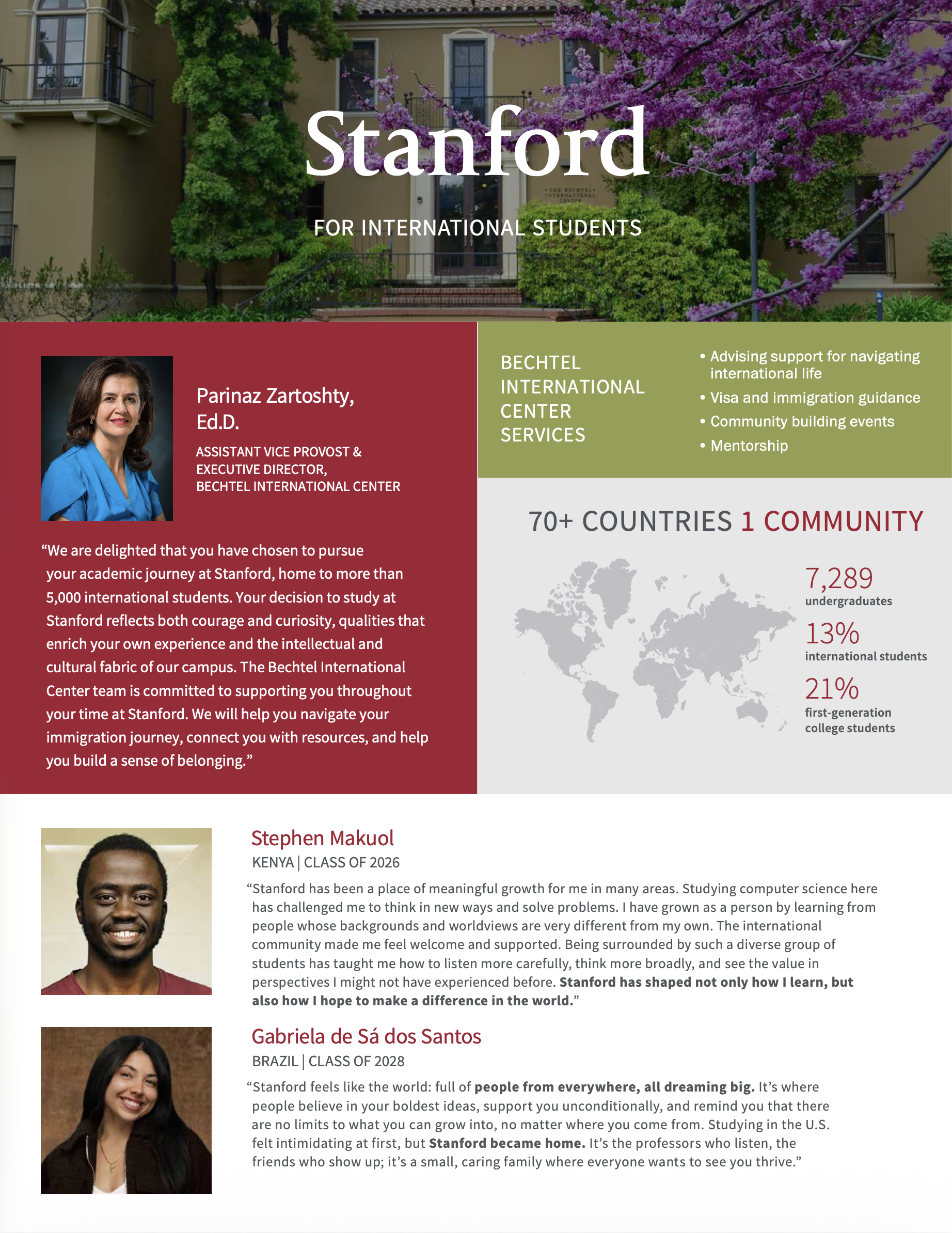
Bechtel International Center is Stanford's hub for international students and families. Please visit their website to learn about the many networks of support available to international students.
We do not have any exchange programs for undergraduates. If you would like to study at Stanford, you will need to apply as a transfer student, or consider graduate programs, the Stanford Continuing Studies program, or Stanford Summer Session. Please note that admission to the summer program is separate from Stanford’s undergraduate admission and does not provide an advantage in the undergraduate admission process.
Prospective graduate applicants, including Law and MBA, will need to contact the specific department or program in which they are interested in to learn more about their specific application requirements. Each individual program has its own application requirements, please visit Graduate Admissions for more information.
Stanford does not award a second bachelor’s degree to individuals who already hold one. If you are interested in studying at Stanford, you can explore Stanford Continuing Studies , or pursue one of our graduate programs . If you are currently an undergraduate student, you can explore transferring as an undergraduate.
The Office of Undergraduate Admission does not partner or work with paid agents or credentialing services. It is expected that all students complete their application materials without the use of such services.

Engage with Us